CalcSolver Free Fraction Calculator 2026
Have you ever looked at numbers like 1/2, 3/4, or 5/8 and wondered what they actually mean? Fractions are one of the most important concepts in mathematics because they represent parts of a whole and appear in almost every area of daily life. Whether you’re measuring ingredients, calculating discounts, comparing values, or solving school assignments, understanding fractions makes every calculation easier.
I created this CalcSolver Fraction Calculator to help you understand fractions from the ground up instead of simply memorizing rules. You’ll learn what a fraction is, how to convert a fraction to a decimal or percentage, simplify and compare fractions, perform arithmetic operations, and understand how my CalcSolver recognizes nd solves fraction problems accurately with step-by-step mathematical logic.
What Is My CalcSolver Fraction Calculator?
A fraction represents a part of a whole that has been divided into equal pieces. If a pizza is divided into 8 equal slices and you eat 3 slices, the amount you have eaten is written as 3/8. This simple idea helps us describe values that fall between whole numbers and is used throughout mathematics and everyday life.

I look at fractions as one of the building blocks of mathematics because they make it possible to compare quantities, measure values, and solve real problems accurately. Whether you want to convert a fraction to decimal, find a fraction to percentage, compare values, or solve calculations using CalcSolver, understanding this concept first makes every other mathematical topic much easier to learn.
Why Fractions Are Important in Mathematics
Fractions are much more than a classroom topic because they help us represent values that cannot be written as whole numbers. I use them constantly when solving measurements, comparing quantities, calculating probabilities, and working with mathematical expressions. Once you understand this concept, many other topics become much easier to learn.
I built CalcSolver to handle these calculations because fractions are closely connected with decimals, percentages, ratios, algebra, and scientific mathematics. Whether you need to compare values, simplify an expression, or convert a value into another form, understanding fractions gives you the confidence to solve mathematical problems accurately and efficiently.

How My CalcSolver Understands Fractions
When you enter a fraction into CalcSolver, I don’t simply perform a calculation and display an answer. The system first recognizes the mathematical structure of your input, identifies the numerator and denominator, and determines what you actually want to do. Whether your goal is to simplify a value, compare two numbers, convert it into a decimal or percentage, or solve a larger expression, the calculator chooses the correct mathematical process automatically.
I designed this intelligent workflow to save you from unnecessary manual steps. Instead of remembering different rules for every situation, you can enter your problem naturally and let CalcSolver analyze it before performing any calculations. This approach improves accuracy, reduces common mistakes, and helps you understand the result with confidence.
Parts of a Fraction
Every fraction is made up of three basic parts, and each one has a specific purpose. Once you understand what these parts represent, reading, comparing, simplifying, and solving mathematical problems becomes much easier. I always recommend learning these fundamentals before moving on to more advanced fraction operations.
Whenever you enter a value into CalcSolver, the system first identifies each part of the fraction before performing any calculation. This allows the calculator to process the expression correctly, apply the appropriate mathematical rules, and generate accurate results every time.
Numerator
The number above the fraction bar that shows how many equal parts are being considered.
Denominator
The number below the fraction bar that shows how many equal parts make up one whole.
Fraction Bar
The horizontal line that separates the two numbers and represents the division operation.
Types of Fractions Explained
Not all fractions represent values in the same way. Some are smaller than one whole, some are greater than one, and others combine whole numbers with fractional values. Learning these different types will help you understand how fractions behave and which mathematical method should be used in different situations.
I designed CalcSolver to recognize every fraction type automatically before starting any calculation. This allows the system to apply the correct mathematical logic whether you’re simplifying, comparing, converting, or solving fraction problems.
Proper Fraction
A proper fraction has a numerator that is smaller than its denominator, which means its value is always less than one whole. For example, 3/5, 2/7, and 5/8 are proper fractions because the top number is smaller than the bottom number. These are the most common fractions used in basic mathematics and everyday measurements.
Improper Fraction
An improper fraction has a numerator that is equal to or greater than its denominator. This means the value is equal to or greater than one whole. Examples include 7/4, 9/5, and 12/6. These fractions often appear in algebra, division problems, and advanced mathematical calculations.
Mixed Fraction
A mixed fraction combines a whole number with a proper fraction. For example, 2 1/3, 4 3/5, and 7 1/2 are mixed fractions. They are commonly used in cooking, construction, engineering, and measurements where quantities are larger than one whole but include an additional fractional part.
Unit Fraction
A unit fraction always has 1 as its numerator. Examples include 1/2, 1/5, and 1/10. Although these fractions look simple, they play an important role in geometry, probability, measurement, and many introductory mathematics concepts.
Like Fractions
Like fractions have the same denominator, making them easy to compare, add, and subtract. For example, 2/9, 4/9, and 7/9 are like fractions because each one is divided into the same number of equal parts.
Unlike Fractions
Unlike fractions have different denominators, so they cannot be added or subtracted directly. For example, 3/4 and 2/5 are unlike fractions because they represent different-sized parts of a whole. Before performing calculations, a common denominator is usually required.
Equivalent Fractions
Equivalent fractions are different fractions that represent exactly the same value even though their numerators and denominators are different. For example, 1/2, 2/4, and 4/8 all represent the same quantity. Understanding equivalent fractions makes it much easier to simplify values, compare numbers, and verify mathematical results accurately.
Fraction to Decimal Explained
Converting a fraction into a decimal is one of the most useful math skills because decimals are easier to compare, measure, and use in calculations. The process is simple. You divide the numerator by the denominator to find the decimal value. Once you understand this method, you can solve many school, financial, and scientific problems more efficiently.
I built CalcSolver to perform this conversion instantly with high precision. Instead of dividing the numbers manually, you can enter any fraction and the calculator automatically calculates the decimal value while maintaining accuracy, even for repeating or long decimal numbers.
1/2
1/4
3/4
2/5
3/5
5/8
7/8
1/3
2/3
5/6
Fraction to Percentage Explained
Converting a fraction into a percentage helps you understand how much a value represents out of one hundred. To do this, first convert the fraction into a decimal and then multiply the result by 100. This method is widely used when calculating grades, discounts, probabilities, statistics, and financial values.
I designed CalcSolver to perform this conversion automatically, so you don’t have to calculate it manually. Simply enter a fraction, and the calculator instantly converts it into its percentage value while maintaining accurate precision for both simple and repeating decimals.
1/2
1/4
3/4
1/5
2/5
3/5
5/8
7/8
1/3
2/3
How to Calculate Fractions Using My CalcSolver
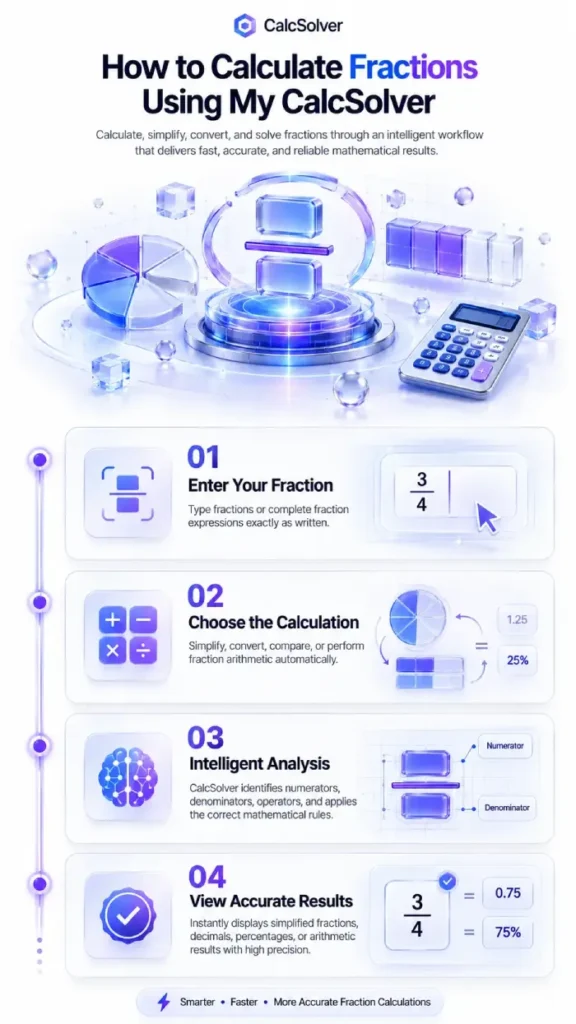
I built CalcSolver to make fraction calculations simple, accurate, and fast. Instead of solving everything manually, you can enter your fraction exactly as you write it on paper, and the calculator will recognize the mathematical structure automatically. Whether you want to simplify a value, compare fractions, convert it into a decimal or percentage, or perform arithmetic operations, the system selects the correct calculation method and produces an accurate result within seconds.
Step 1: Enter Your Fraction
Type the fraction into the calculator using the standard format, such as 1/2, 3/4, or 5/8. You can also enter complete expressions like 1/2 + 3/4 or 5/6 × 2/3 without converting them first.
Step 2: Choose the Calculation
After entering your expression, decide what you want to do. You can simplify a fraction, convert it to a decimal or percentage, compare two values, or solve addition, subtraction, multiplication, and division problems.
Step 3: Let CalcSolver Analyze the Expression
Once you submit the calculation, I automatically identify the numerator, denominator, mathematical operators, and overall expression. The system then selects the correct mathematical rules before performing any calculations to ensure maximum accuracy.
Step 4: View the Result
Within moments, CalcSolver generates the final answer. Depending on your calculation, it may display the simplified fraction, decimal value, percentage, or the complete result of the arithmetic operation, allowing you to continue solving your mathematical problem with confidence.
The Commutative Property applies only to addition and multiplication. It does not work for subtraction or division. For example, 8 − 3 ≠ 3 − 8, and 12 ÷ 4 ≠ 4 ÷ 12. My CalcSolver Algebra Solver automatically recognizes where this property can be applied and avoids using it in situations where changing the order would produce an incorrect answer.
FAQs
Conclusion
Fractions are one of the most important concepts in mathematics because they help us represent, compare, and calculate values that cannot be expressed using whole numbers alone. Once you understand how fractions work, converting them into decimals or percentages, simplifying them, comparing values, and performing arithmetic operations becomes much more straightforward. Building a strong foundation here will also make topics such as algebra, ratios, proportions, and percentages easier to understand.
I created this guide to explain fractions in a practical and easy-to-follow way instead of relying on memorization. Whenever you need to simplify a value, convert it, or solve a fraction problem accurately, you can use CalcSolver. The calculator automatically recognizes the mathematical structure, applies the correct calculation method, and delivers reliable results, helping you solve problems faster while strengthening your understanding of mathematics.